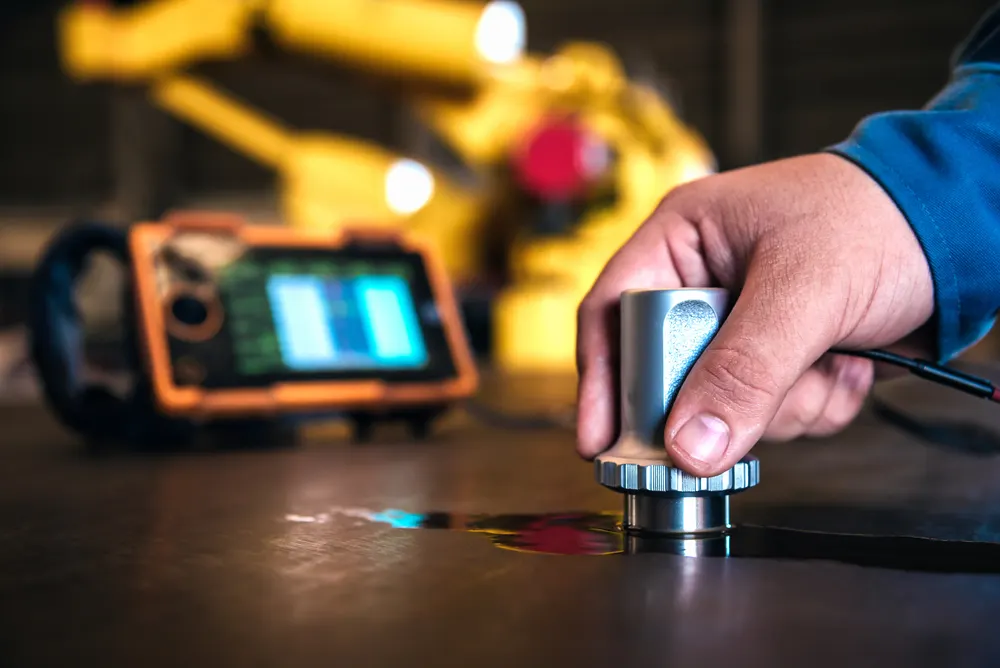
Non-destructive testing (NDT) is the general name for methods that find defects inside and on the surface of a material, weld or component without impairing its fitness for use. The part stays in service after the inspection, which is why NDT is used both for quality control in manufacturing and for the periodic inspection of equipment in operation.
What Is Non-Destructive Testing Used For?
- Finding defects in welds such as cracks, porosity, slag inclusions and lack of fusion.
- Revealing internal discontinuities in castings and forgings.
- Showing whether pressure vessels, pipelines and lifting equipment can safely stay in service.
- Detecting faults before they lead to failure, reducing unplanned downtime and costs.
5 Core Non-Destructive Testing Methods
1. Visual Testing (VT)
The most basic method and always the first to be applied. Visible surface defects are examined with the naked eye, a magnifier or a camera. More on visual testing.
2. Liquid Penetrant Testing (PT)
Used to find cracks and pores that are open to the surface. A coloured or fluorescent liquid applied to the surface seeps into the defects and is made visible by a developer. More on penetrant testing.
3. Magnetic Particle Testing (MT)
Finds surface and near-surface defects in ferromagnetic materials. The part is magnetised, and the magnetic flux leakage at a defect becomes visible through particles sprinkled over it. More on magnetic particle testing.
4. Ultrasonic Testing (UT)
High-frequency sound waves are used to find internal defects and measure wall thickness. Its main advantage is that it can find deep defects with access from one side only. More on ultrasonic testing.
5. Radiographic Testing (RT)
An image of the internal structure of the material is taken with X-rays or gamma rays. Because it provides a permanent record, it is widely used for inspecting welds. More on radiographic testing.
Which Method Should You Choose?
The method is chosen according to the material, whether the defect is on the surface or inside, the geometry of the part and the applicable standard. Most projects use more than one method together.
For on-site non-destructive testing anywhere in Türkiye, you can browse our NDT services or contact us.