
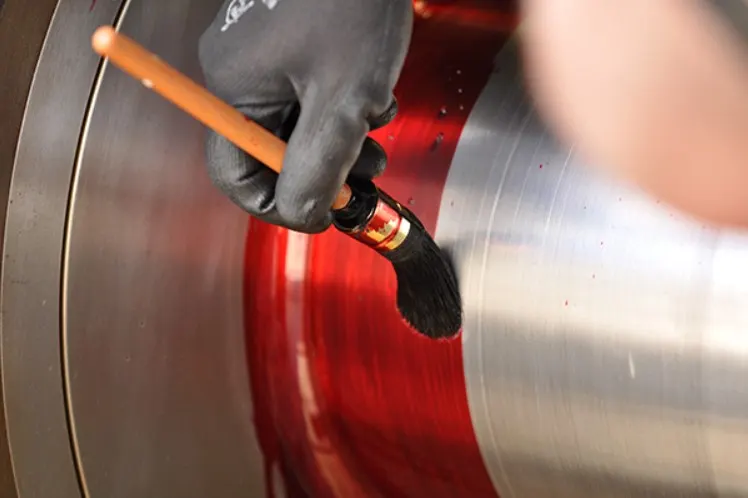
Liquid penetrant inspection (PT, also called dye penetrant testing) is a non-destructive testing method for finding surface-breaking discontinuities in non-porous materials. It relies on capillary action: a low-viscosity liquid applied to the surface is drawn into narrow openings such as cracks, then pulled back out by a developer so that the defect becomes visible. FKT NDT carries out liquid penetrant testing on site.
Where It Is Used
Penetrant testing works on almost any non-porous material, including carbon and stainless steel, aluminium, copper alloys and many non-metallic materials. It is the standard choice for surface cracks in non-magnetic materials.
- Welds: cracks, porosity, undercut, overlap, and lack of fusion or incomplete penetration that breaks the surface
- Castings: hot tears, porosity, gas holes and shrinkage
- Forgings: cracks, laps and surface seams
- Rolled products: cracks, seams and laminations open to the surface
- In-service equipment: fatigue and stress corrosion cracks in pressure vessels, piping, pump and valve bodies and machine parts
What It Detects and Its Limits
As long as a defect is open to the surface, penetrant testing can show even very fine cracks. Its limits are equally clear:
- Only surface-breaking discontinuities are found; subsurface defects are not
- Not suitable for porous materials such as some castings and ceramics
- Paint, coatings, rust and oil can seal a crack, so surface cleaning is critical
- It gives no information on the depth of a defect
For near-surface defects in ferromagnetic steel, magnetic particle testing is used; for internal defects, ultrasonic testing.
Penetrant Types and Methods
There are two basic penetrant types: fluorescent, which is viewed under UV-A light, and visible colour-contrast (usually red penetrant on a white developer), which is viewed under white light. By the way excess penetrant is removed, the methods are:
- Water-washable
- Post-emulsifiable, lipophilic
- Solvent-removable
- Post-emulsifiable, hydrophilic
The type and method are chosen for the required sensitivity level (1 to 4), the size of the part and the site conditions. In the field, solvent-removable colour-contrast systems in aerosol cans are the most common.
Standards
Penetrant testing is commonly applied according to:
- EN ISO 3452-1 – Penetrant testing, general principles
- EN ISO 3452-2 – Testing of penetrant materials
- EN ISO 23277 – Penetrant testing of welds, acceptance levels
- ASME Section V, Article 6 – Liquid penetrant examination
- ISO 9712 – Personnel certification
How the Inspection Works
- Pre-cleaning: the surface is cleaned of oil, paint, rust and dirt, then dried.
- Penetrant application: penetrant is applied by spray, brush or immersion and left for the dwell time given in the procedure.
- Excess removal: surplus penetrant is removed from the surface without washing it out of the defects.
- Developer: a thin, even developer layer draws the penetrant back to the surface.
- Evaluation and reporting: indications are examined under suitable lighting, assessed against the acceptance criteria and reported. The report covers the part, the consumables, the standard, the findings and the result. The surface is cleaned after testing.
Key Advantages
- Relatively easy to apply
- Works on a wide range of materials
- Large areas and large numbers of parts can be inspected quickly and at low cost
- Parts with complex shapes are easy to inspect
- Indications form directly on the part, giving a visual picture of the defect
- Aerosol cans make the equipment highly portable
FAQ
Which materials can be penetrant tested?
Almost any non-porous material: carbon and stainless steel, aluminium, titanium, copper alloys, and some plastics and ceramics.
Penetrant or magnetic particle testing?
On ferromagnetic steel, magnetic particle testing is usually faster and also finds near-surface defects. On non-magnetic materials such as stainless steel or aluminium, penetrant testing is the method of choice.
What is the difference between fluorescent and visible penetrant?
Fluorescent penetrant is viewed under UV-A light in darkened conditions and offers higher sensitivity. Visible penetrant is viewed in white light and is more practical on site.
Can penetrant be applied over paint?
No. Paint and coatings close the mouth of a crack, so they must be removed before testing.
For a liquid penetrant testing quote, please reach us through our contact page.