
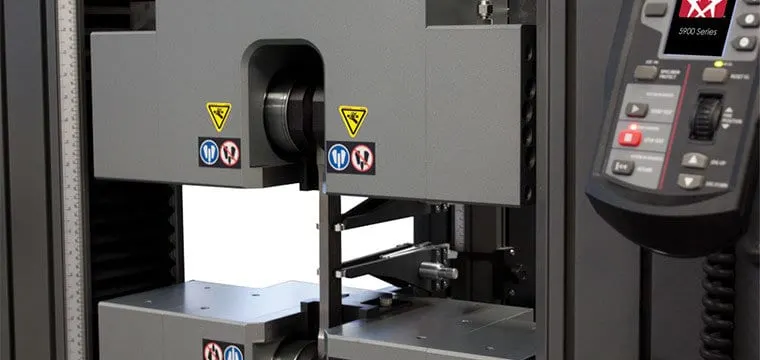
A tensile test is a destructive mechanical test in which a specimen is pulled axially at constant temperature until it fractures, in order to determine the strength properties of the material under static (non-impact) load. Force and extension are recorded throughout the test, producing the stress-strain curve of the material. FKT NDT provides tensile testing as part of its destructive inspection services.
What Does a Tensile Test Measure?
The tensile test gives the following mechanical properties of the material represented by the specimen:
- Yield strength (ReH / ReL), or 0.2% proof strength (Rp0.2) for materials without a distinct yield point
- Maximum force (Fm)
- Tensile strength (Rm)
- Percentage elongation after fracture (A)
- Percentage reduction of area (Z), when required
These values show whether a material meets its ordered grade and the strength values assumed in design. For welded joints, they show whether the joint is at least as strong as the parent metal.
Where Is It Used?
- Welding procedure qualification (WPQR): transverse specimens taken from butt-welded test pieces verify the tensile strength of the joint.
- Material acceptance: verifying the values on mill certificates for plate, sections, pipe and bar.
- Production control: monitoring consistency with specimens taken during production.
- Failure investigation: establishing the actual properties of a suspect material.
Tensile tests are usually part of a wider test programme. A procedure qualification, for example, typically also includes bend tests, Charpy impact tests and hardness tests.
Standards
Depending on the customer specification and product standard, tensile testing is commonly applied according to:
- ISO 6892-1: Metallic materials – Tensile testing – Method of test at room temperature
- ISO 4136: Destructive tests on welds in metallic materials – Transverse tensile test
- ISO 5178: Longitudinal tensile test on weld metal
- ASTM E8/E8M and ASTM A370: for projects working to American standards
- ISO 15614-1 and ISO 9606-1: the procedure and welder qualification standards that define the test programme and acceptance criteria
How the Test Is Performed
- Specimen preparation: the specimen is cut, machined and marked in the orientation and dimensions defined by the standard. In welded specimens, the weld sits at the centre of the specimen.
- Measurement: cross-section dimensions and original gauge length are recorded.
- Testing: the specimen is gripped in the tensile machine and loaded to fracture within the rate range specified by the standard.
- Evaluation: yield and tensile strength are calculated from the force-extension curve and elongation is measured after fracture. For welds, the fracture location (weld metal, heat-affected zone or parent metal) is noted.
- Reporting: the report includes specimen identification, dimensions, the standard applied, results, fracture location and assessment against the acceptance criteria.
FAQ
What is the difference between yield strength and tensile strength?
Yield strength is the stress at which the material begins to deform permanently. Tensile strength is the maximum stress the material can carry. Design is usually based on yield strength.
Does a weld specimen fail if it breaks in the weld?
Not necessarily. In a transverse tensile test, the joint is generally required to reach the specified minimum tensile strength of the parent metal. The fracture location is reported and assessed against the applicable standard.
How many specimens are needed?
It depends on the standard and specification. For a welding procedure qualification, two transverse tensile specimens are typically taken from the test piece.
Why does elongation matter?
Elongation indicates ductility. A material with high strength but low elongation can be more prone to sudden, brittle failure.
To arrange tensile testing, contact us with your specimen details and the applicable standard, and we will prepare a quotation.